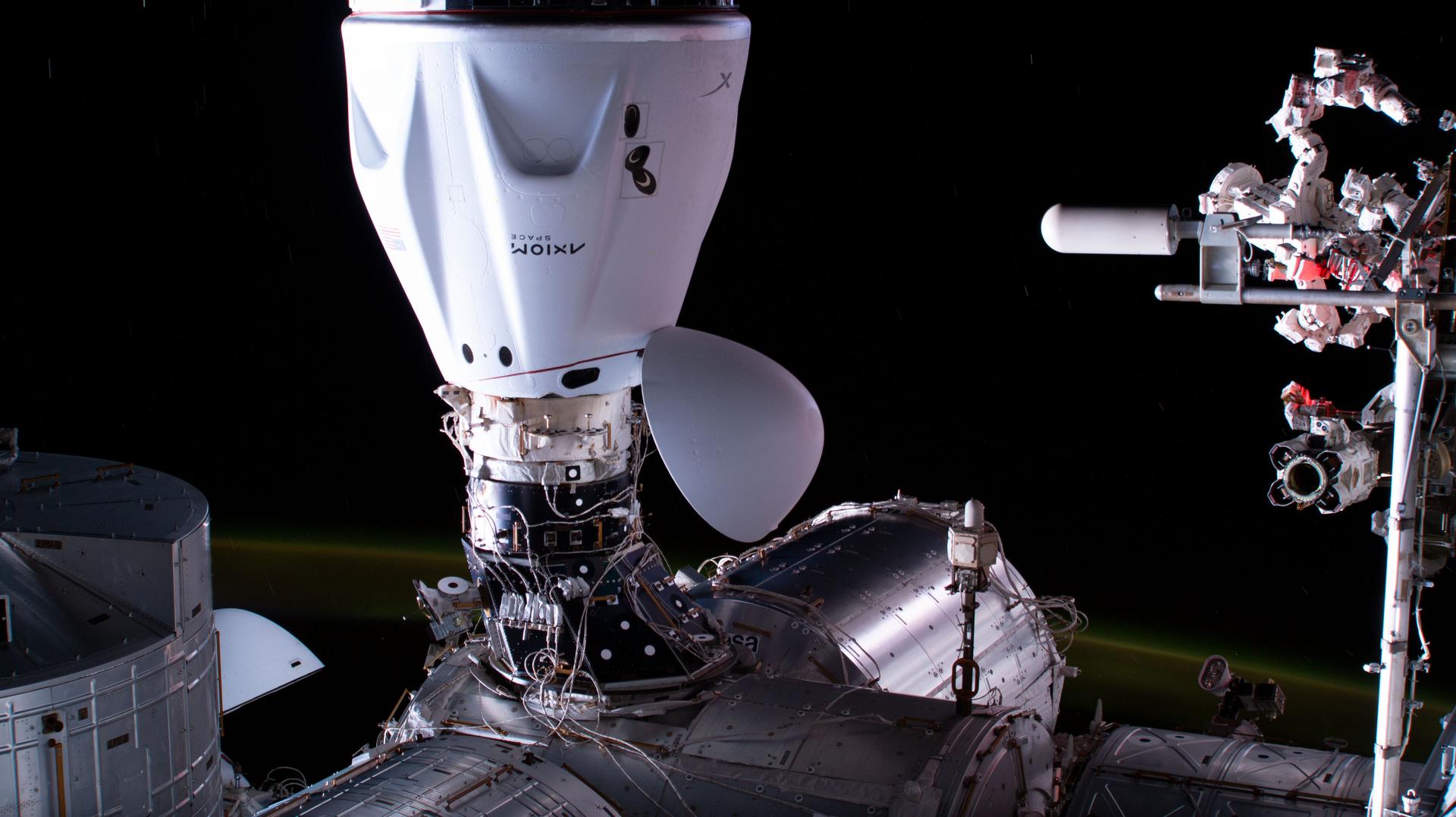
Axiom Space is not simply building a commercial space station. It is attempting something more difficult and more consequential: managing the transition from an ISS-anchored, mission-defined orbital economy to a post-ISS market structure that can persist without collapsing demand.
While many observers see Axiom’s reliance on government and sovereign customers as a weakness it must outgrow, that framing is backwards. Axiom isn’t waiting for private demand to mature — it is trying to manufacture a market structure out of repeat sovereign procurement, while others build infrastructure on the assumption that commercial utilization will arrive on schedule.
Enabling a Sustained Human Presence in Space
Axiom Space is often described as a company building a commercial space station. That description is accurate, but incomplete in a way that obscures the company’s real strategic ambition.
Axiom is not merely attempting to replace the International Space Station (ISS). It is attempting to solve a harder problem: how to build a sustainable human spaceflight ecosystem that lasts beyond the ISS-era.
Axiom’s strategy is simple: rather than waiting for a hypothetical commercial market to materialize, the company is deliberately constructing a post-ISS market by aggregating global sovereign demand for human access to orbit, turning what were once episodic diplomatic missions into a repeatable, purchasable service. That global demand provides a revenue stabilizer supporting the infrastructure as new commercial models are proven out and build momentum.
In that sense, Axiom’s core product is not a station at all, but a missions-as-a-service model that preserves operational, political, and economic continuity across a fragile transition.
Axiom’s Architectural Bet: Productize the Substrate, Customize the Market
Axiom’s approach only works if continuity does not come at the expense of long-term innovation. To manage that tension, Axiom is making a clear architectural choice: separating the platform into a standardized substrate and a customizable delivery layer.
What Axiom Is Standardizing
Axiom is deliberately locking down the elements of the system that must scale, amortize, and remain stable over decades:
- Core habitat and pressure vessel architectures
- Life support, power, thermal control, and safety baselines
- Docking, berthing, and interoperability interfaces
- Crew operations, training pipelines, and certification regimes
- Regulatory and safety relationships with NASA and international partners
- Operational cadence, logistics integration, and on-orbit procedures
These components form the substrate. Standardizing them reduces cost, increases reliability, and prevents early customers from hard-coding bespoke requirements into the core platform.
What Axiom Is Leaving Flexible
At the same time, Axiom is intentionally not standardizing the elements through which demand, politics, and value expression vary:
- Mission-specific payloads and research equipment
- Interior configuration and utilization profiles
- National branding, program framing, and crew composition
- Mission duration, cadence, and operational emphasis
- Commercialization and data-rights structures downstream
This delivery layer is where differentiation, experimentation, and learning occur. The result: a system that can support Italian, Turkish, Emirati, Saudi, or other national missions as products, rather than as bespoke infrastructure projects.
Why This Matters: From Missions to a Market
This separation between substrate and delivery is what allows Axiom to pursue its most differentiated move: turning fragmented, mission-era sovereign demand into a durable, multi-buyer market for human spaceflight services.
Historically, human access to orbit has been coordinated diplomatically and funded programmatically. Axiom is pushing that access one step further down the value chain into procurement: countries can simply buy missions. But that shift only works if the underlying system remains stable while customers rotate.
The company is not betting on predicting which commercial use cases will dominate in LEO. It is betting that if access is standardized and demand is aggregated across many sovereign buyers, sustained operations can be justified before purely private markets require them.
The open questions: Can Axiom preserve this discipline as customer pressure grows? Can the market it is assembling maintain cadence and utilization once the ISS is gone?
Government Demand as the Market-Construction Engine
Axiom’s reliance on government customers is often seen as a transitional necessity. That framing understates what the company is actually doing.
Axiom is deliberately constructing a repeatable market out of global, sovereign demand for human access to orbit — and doing so in a way that can persist after the ISS-era institutional framework disappears.
This demand comes from a growing set of countries that want astronaut participation without operating a national human spaceflight program, repeat participation rather than one-off diplomatic flights, and prestige branding as a spacefaring nation. Most of the nations represented to date — Canada, India, Israel, Italy, Hungary, Poland, Saudi Arabia, Spain, Sweden, and Turkey — lack independent crewed launch and station infrastructure but are willing buyers of missions as a service.
Essentially, Axiom is productizing missions while standardizing the procurement pathway for human access to orbit — turning bespoke diplomacy into repeatable buying behavior.
How Axiom’s Approach Differs From Other Commercial Station Strategies
The leading programs are pursuing meaningfully different strategies around how demand is expected to form and how platforms are structured to serve it.
- Axiom organizes its early strategy around repeat sovereign human spaceflight and private astronaut missions, using those missions to establish operational cadence, customer continuity, and standardized procurement pathways.
- Orbital Reef (Blue Origin / Sierra Space) positions itself as a mixed-use orbital “business park,” with a broad utilization thesis spanning government research, commercial R&D, industrial activity, biomanufacturing, tourism, and logistics.
- Starlab (Voyager Space / Airbus) is most explicitly oriented toward continuity of ISS-style research and institutional science. Commercial utilization is framed as incremental rather than foundational.
- Vast prioritizes speed to initial crewed operations through smaller, focused platforms (Haven-1) aimed at near-term microgravity research and manufacturing.
These are not simply competing visions of the potential market. They are different answers to the same underlying question: how to sustain continuous operations in low Earth orbit before purely commercial demand is sufficient to do so.
Where Axiom’s Strategy Can Fail — and the Discipline It Requires
Axiom’s approach is coherent, but it is not self-executing. Several failure modes are worth highlighting.
1. Customization Creep Into the Substrate
The company will face ongoing pressure to accommodate unique national requirements. If those requirements leak into the standardized substrate rather than remaining confined to the delivery layer, the result will be rising costs, schedule risk, and scalability erosion. This is the same trap that kept satellite manufacturers locked in low-volume, high-cost production for decades: every customer requirement that touched the bus meant the next satellite couldn’t reuse the learning from the last one.
What this requires: Clear internal guardrails that prevent customer-specific demands from reshaping the core platform, even when those customers are politically or financially attractive.
2. Demand Fragmentation Without Cadence
The limiting factor will not be whether Axiom can fly missions. It will be whether it can sustain a predictable, high-tempo operating rhythm that keeps crews trained, logistics flowing, and buyers returning on schedule. The risk is not a lack of demand, but a lack of rhythm.
What this requires: Multi-mission agreements, repeat customers, and scheduling discipline that prioritizes cadence over symbolic diversity.
3. Overestimating the Speed of Commercial Pull-Through
Commercial use cases will emerge, but unevenly and more slowly than infrastructure timelines will likely assume. The risk is not that commercial demand never arrives, but that it arrives later and in different forms than expected.
What this requires: A willingness to let sovereign demand carry utilization longer than planned, without forcing premature commercial narratives that distort platform decisions.
The common thread is discipline: protect the substrate, sell repeatability, and avoid letting early buyers define the platform.
What Axiom’s Approach Reveals — and What Remains Unproven
Axiom has not yet demonstrated that it has built a winning post-ISS business. Its station has not flown, long-term utilization remains unproven, and the durability of demand beyond early missions is still an open question.
What Axiom is demonstrating is something more subtle: a coherent theory of how markets for complex space infrastructure are actually formed — one that does not rely on rapid private-sector adoption or on a single anchor customer.
Lesson 1: Customization Must Live Above the Substrate
The strategic mistake is allowing customer requirements to reshape the core system each time a new buyer appears. Long-term innovation depends on freezing the right layers early. Customization should shape the experience, not the substrate.
Lesson 2: Repeatability Is the Gateway to Quality and Reliability
Markets do not mature through isolated successes. They mature through repetition. Repeatability is not a nice-to-have; it is the mechanism by which quality emerges.
Lesson 3: Markets Do Not Have to Be Purely Private to Be Real
What matters is not the identity of the buyer, but the structure of the product. Serving multiple sovereign buyers through a standardized offering is categorically different from acting as outsourced capacity for one institution.
Lesson 4: Slow Commercial Formation Is Not a Death Sentence
Companies that recognize the current moment — where sovereign actors are increasingly motivated to build space capability for strategic and geopolitical reasons — and design products that can absorb that demand without becoming captive to it, can build sustainable, market-oriented platforms even in the absence of rapid commercial pull-through.
The Open Question
The decisive test will come when multiple post-ISS platforms are competing for the same finite pool of sovereign and institutional buyers. In that environment, “vision” will matter less than cadence, cost, reliability, and the ability to keep customization from contaminating the substrate.
If Axiom’s discipline holds, it will have shown that markets for complex space infrastructure do not need to be discovered. They can be designed.
If it doesn’t, the lesson will be just as important: in space, losing architectural and operating discipline under early customer pressure is how market formation fails — quietly, and long before the market ever has a chance to arrive.